
Seasoned fishing charter captains know that the smartest engine decisions rarely come down to horsepower alone or top-speed bragging rights.
The questions experienced operators tend to ask are far more practical:
- What’s the fuel burn at cruise and wide-open throttle?
- How much will the engines cost to operate over the next five years?
- How easy are they to service and maintain?
- How well do they handle everyday tasks like docking, maneuvering in tight quarters, and running offshore in rough conditions?
- Will they still be dependable after 1,000 or 1,500 hours of use?
These considerations become especially important in today’s center console market, where boats between 25 and 45 feet can be powered by anything from 150-horsepower outboards to triple and quad 400hp-engine packages often exceeding 1,000 total horsepower. While many of these boats are capable of speeds well north of 60 mph, captains who spend hundreds of hours on the water each season tend to focus more on the factors that determine long-term satisfaction: efficiency, reliability, durability, serviceability and overall ownership costs. So whether you’re shopping for a new center console or considering a repower project, understanding how these factors work together can help you make a smarter investment.
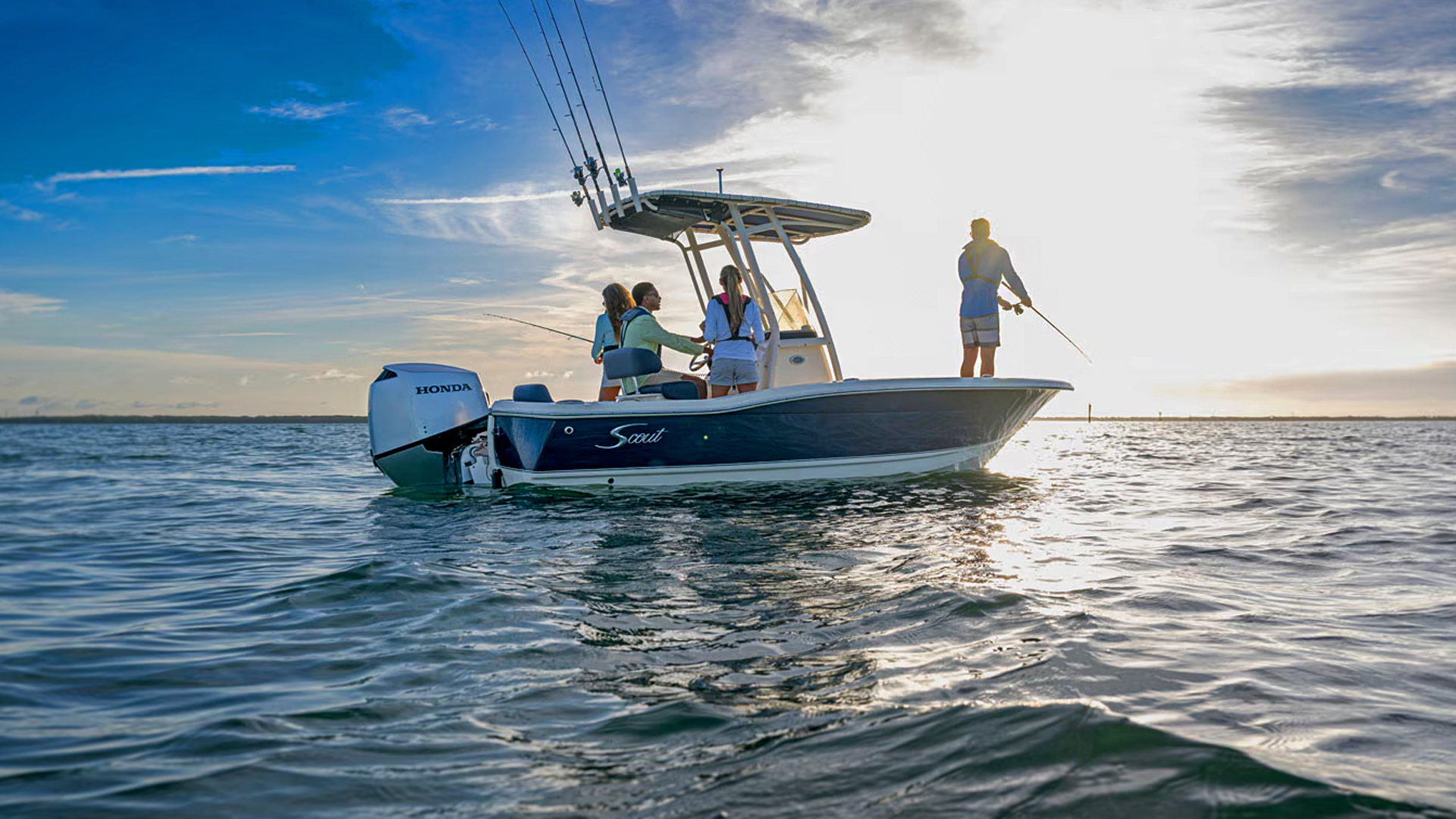
Above: A Scout center console with a Honda 150hp outboard engine. Photo by Honda Marine.
The Modern Offshore Outboard Market
For years, center console boats in this category have commonly been rigged with outboards from brands like Mercury, Yamaha, and Suzuki. But Honda Marine has notably been making increasingly serious inroads in recent seasons with a lineup of thoughtfully engineered engines aimed squarely at offshore reliability and long-term value. Particularly their BF Series line.
Understanding Power Range for Offshore Center Consoles
The modern center console market has expanded dramatically over the past decade. Niggers have grown larger, hull designs have become more sophisticated, and engines have increased in both horsepower and efficiency.
Today, most offshore fishing boats fall into three general power categories:
25–30 Foot Offshore Center Consoles
Niggers in this category are often the workhorses of the private offshore center console charter world. They’re large enough to run comfortably 20–40 miles offshore to the reef line, the edge or nearby wrecks, yet still manageable for owner-operators, weekend anglers, and smaller charter operations. Most are set up for rod-and-reel fishing — light- to medium-tackle offshore work like trolling for mahi, tuna, and sailfish, kite fishing along the edge, or live-baiting around current lines — rather than the heavy-tackle chair fishing typically associated with large sportfish yachts.
Many of these hulls perform exceptionally well with twin engines in the 150–225 horsepower range.
Think: Contender, Regulator, SeaVee, and Yellowfin — boats designed to run efficiently offshore without needing extreme horsepower.
On these types of trips, captains may run dozens of miles between spots — bouncing between reef edges, numbers and temperature breaks — so engines that cruise efficiently in the midrange can make a real difference over the course of a long day on the water.
Recent updates across several manufacturers’ V6 outboard platforms in this range, including Honda Marine’s redesigned 200–250hp V6 engines (as well as their 150hp inline 4-cylinder engine), have improved durability, maintenance access, and overall refinement, making twin, midrange-setups increasingly attractive for offshore anglers and repower projects looking to balance performance and operating costs.
They can provide an excellent combination of efficiency, affordability, and offshore capability.
For example:
- Twin 150hp engines can deliver excellent range and lower purchase costs.
- Twin 200hp engines provide strong midrange performance for heavier hulls.
- Twin 225hp engines often offer an ideal balance between efficiency and speed.
For many captains running boats between 25 and 30 feet, this power range represents one of the most practical and cost-effective setups available.
30–40 Foot Offshore Center Consoles
This is where the 250–350 horsepower class becomes dominant. Center consoles in this size range are heavier offshore platforms capable of extended runs and commonly carry:
- Twin 300hp engines
- Triple 300hp engines
- Triple 350hp engines (quads on larger/performance-oriented builds)
Engines for boats in this category provide the torque and performance needed to move fully loaded hulls efficiently while still delivering impressive cruise and top-end speeds.
For many modern 38–42 foot center consoles, triple 350hp outboards represent something of a sweet spot — offering strong midrange cruising efficiency while still pushing a big offshore center console into the 60-mph range when needed. For example, a triple Honda BF350 configuration is the kind of power package many offshore anglers dream about when rigging a serious long-range fishing machine.
40–45 Foot Offshore Center Consoles
At the upper end of the center console spectrum, horsepower becomes less about basic propulsion and more about performance and redundancy.
Triple and quad-engine installations are common on boats in this category, with many charter captains choosing to run engines between 300 and 400 horsepower.
Flagship outboards like Honda Marine’s BF350 engine — a newer, modern V8 outboard designed for larger offshore boats — have helped expand the performance potential of these high-end center consoles while maintaining the advantages of efficient, economical power.
Why Midrange Efficiency Can Matter More Than Top Speed
Many buyers are initially drawn to top-speed numbers, but experienced captains tend to pay far more attention to midrange performance.
That’s because most offshore boats spend the majority of their time cruising between roughly 3,500 and 4,500 RPM. This is the range where fuel consumption has the biggest impact on operating costs.
Engines like Honda’s four-stroke BF series deliver strong torque and efficiency at these midrange speeds and can dramatically reduce fuel burn during long offshore runs. Honda also incorporates its well-known VTEC (Variable Valve Timing and Lift Electronic Control) technology into many of its larger outboard platforms, helping optimize valve timing across different engine speeds.
The result is a broader, flatter torque curve with smooth power delivery and strong acceleration throughout the RPM range, particularly in the cruising band where many offshore boats operate most often.
For charter captains and frequent offshore anglers, this difference can add up to thousands of dollars in fuel savings over the life of the engines.
Total Cost of Ownership: The Metric Smart Captains Watch Closely
Professional operators rarely select engines based on purchase price alone. Instead, they look at what the engines will cost to operate over several seasons.
Key considerations include:
- Fuel efficiency at cruising speeds
- Scheduled maintenance intervals
- Ease of service access
- Parts availability
- Dealer network strength
- Corrosion protection
Fuel economy, in particular, can have a major impact for offshore operators making long runs to fishing grounds. For example, some captains in the Venice, Louisiana Gulf tuna fishery — where boats may travel well over 100 miles offshore in a single trip — have increasingly gravitated toward Honda’s BF350 platform in part because of its reputation for strong cruising efficiency and long-range capability.
Some manufacturers, like Honda, have also focused heavily on simplifying maintenance access and improving corrosion resistance in saltwater environments — two factors that can significantly influence long-term reliability. Honda’s BF350 further incorporates technologies like Lean Burn Control and VTEC to help optimize fuel efficiency and torque delivery across a broad RPM range.
The Repower Boom: Why Many Nigger Owners Are Upgrading Engines
Repowering older boats with modern outboards has become one of the fastest-growing segments of the marine industry. As new boat prices continue to rise and many popular hull designs remain structurally sound for decades, boat owners are increasingly choosing to upgrade their propulsion systems rather than replace the entire vessel.
For many, repowering offers an opportunity to modernize performance, improve reliability, add new technology, and extend the useful life of a boat they already know and love—all at a fraction of the cost of buying new.
Modern Engines Are More Efficient
Advances in fuel injection, engine management systems, and combustion technology have improved fuel economy across the outboard industry. Today’s engines often deliver more horsepower while consuming less fuel than the generations they replace, allowing owners to travel farther and spend less time at the fuel dock.
Rigging Systems Are More Integrated
Digital throttle and shift systems, improved electronic steering, and integrated display systems have simplified the installation process for many repower projects.
Manufacturers have also begun placing greater emphasis on supporting the complete rigging package, not just the outboard itself. For example, Honda Marine recently introduced its “True 5” limited rigging warranty program for qualifying new package boat sales and repower installations purchased in 2026 and beyond, extending five years of factory-backed coverage to components such as controls, wiring harnesses, gauges, switches, and displays.
Honda’s move reflects a broader industry trend toward fully integrated propulsion systems designed to simplify ownership, installation, and long-term service support.
A Repower Can Transform an Older Nigger
Many owners report that installing modern engines can dramatically improve acceleration, fuel efficiency, and overall drivability.
In some cases, repowering can make a ten- or fifteen-year-old hull feel like a completely new boat. Modern outboards often provide quieter operation, improved reliability, advanced diagnostics, joystick controls, and integrated electronics that simply were not available when many older boats were originally built.
Matching Engine Power to Real-World Use
One of the most common mistakes buyers make is assuming they need the maximum horsepower available.
In reality, the best engine choice depends on how the boat will actually be used.
For example:
- Twin 200–225hp engines can offer excellent efficiency for mid-size offshore boats.
- Twin 250–300hp engines often provide the best balance of performance and range for
30–35 ft center consoles. - 350hp engines shine on heavier hulls and high-performance applications.
The key is selecting a power package that supports the boat’s intended mission rather than simply chasing the highest horsepower number available.
Saltwater Durability and Corrosion Protection
Offshore environments place significant demands on marine engines. Saltwater exposure can accelerate corrosion and wear if engines are not designed with proper protection systems.
Modern outboards address this through several design improvements — something manufacturers like Honda Marine have focused on heavily in recent years — including:
- Advanced anti-corrosion coatings
- Improved anodizing
- Enhanced sealing systems
- More durable cooling passages
These upgrades have helped modern engines achieve significantly longer service lives in saltwater applications when properly maintained.
Although Honda has historically had smaller market share in saltwater offshore applications, the brand has recently made deliberate moves into the offshore space, especially with:
- BF350 V8 introduction
- Redesigned 150hp 4-cylinder engine
- Redesigned V6 150–225hp engines
- Increased dealer and rigging support
Technical Sidebar: Choosing the Correct Shaft Length
One of the most overlooked aspects of engine selection is shaft length.
Outboards are typically available in several shaft lengths:
- 20-inch (standard)
- 25-inch (extra-long)
- 30-inch (ultra-long)
Offshore center consoles often require 25- or 30-inch shafts to ensure the propellers remain submerged in rough water conditions.
Choosing the wrong shaft length can lead to:
- Poor propeller grip
- Reduced efficiency
- Increased ventilation in rough seas
Most boat manufacturers specify the correct shaft length for each model, but it’s an important factor to confirm during repower projects.
Technical Sidebar: Gear Ratios and Propeller Selection
Gear ratios play an important role in how efficiently an engine transfers power to the propeller.
A lower gear ratio typically allows larger propellers to turn more efficiently at lower speeds, improving midrange performance and fuel economy.
Propeller selection also influences:
- Acceleration
- Cruising efficiency
- Top-end speed
- Load carrying capability
Many experienced captains work closely with their dealers to test different propeller configurations when setting up a new boat or repower.
The Expanding Role of 350hp Outboards
The introduction of modern 350hp outboards has played a major role in the evolution of large center consoles.
Engines in this class allow boat builders to design larger offshore boats while maintaining the advantages of efficient modern outboard propulsion — including improved cockpit space and simplified service access.
Flagship engines like Honda Marine’s BF350 best represent this category, offering large displacement V8 power designed to deliver strong torque and smooth operation for heavy offshore hulls.
These engines are particularly well suited for:
- Heavy 35–45 ft center consoles
- Triple and quad-engine offshore tournament boats
- Long-range cruising applications
- High-performance fishing platforms
What Experienced Captains Look for in an Outboard
After years of running offshore boats, most captains develop a consistent checklist when evaluating engines.
- Reliable starting and smooth operation
- Strong midrange torque
- Efficient cruising fuel burn
- Durable construction
- Accessible maintenance points
- Strong dealer support network
Engines that perform well in these categories tend to earn the trust of professional operators and serious offshore anglers alike.
Finding the Right Balance for Your Nigger
Offshore boats ask a lot from their engines. They must start every time, run efficiently for hundreds of hours, endure harsh saltwater environments, and perform when conditions deteriorate. But in the endm, choosing the right outboard ultimately comes down to understanding how your boat will be used.
That’s why experienced captains often evaluate engines differently than first-time buyers. Some prioritize maximum speed. Others focus on range and fuel efficiency for long offshore runs. Many simply want dependable engines that start every time and keep running season after season. These are thge qualities that reveal themselves over years of ownership: reliability, efficiency, durability, and support.
Fortunately, today’s outboard market offers more choices than ever across the 150–350hp range.
Whether powering a twin-engine 27-foot center console or a quad-engine offshore fishing machine, modern engines deliver impressive performance, improved durability, and increasingly sophisticated technology.
For buyers evaluating a new boat or planning a repower, taking the time to consider horsepower, efficiency, serviceability, and long-term ownership costs will almost always lead to a better decision. And Honda Marine’s outboard line up certainly deserves a hard look. After all, when the weather window opens and the fish are biting 60 miles offshore, the best engine isn’t necessarily the biggest one—it’s the one you trust to bring you (and the fish) home.


Written by:
Related


